

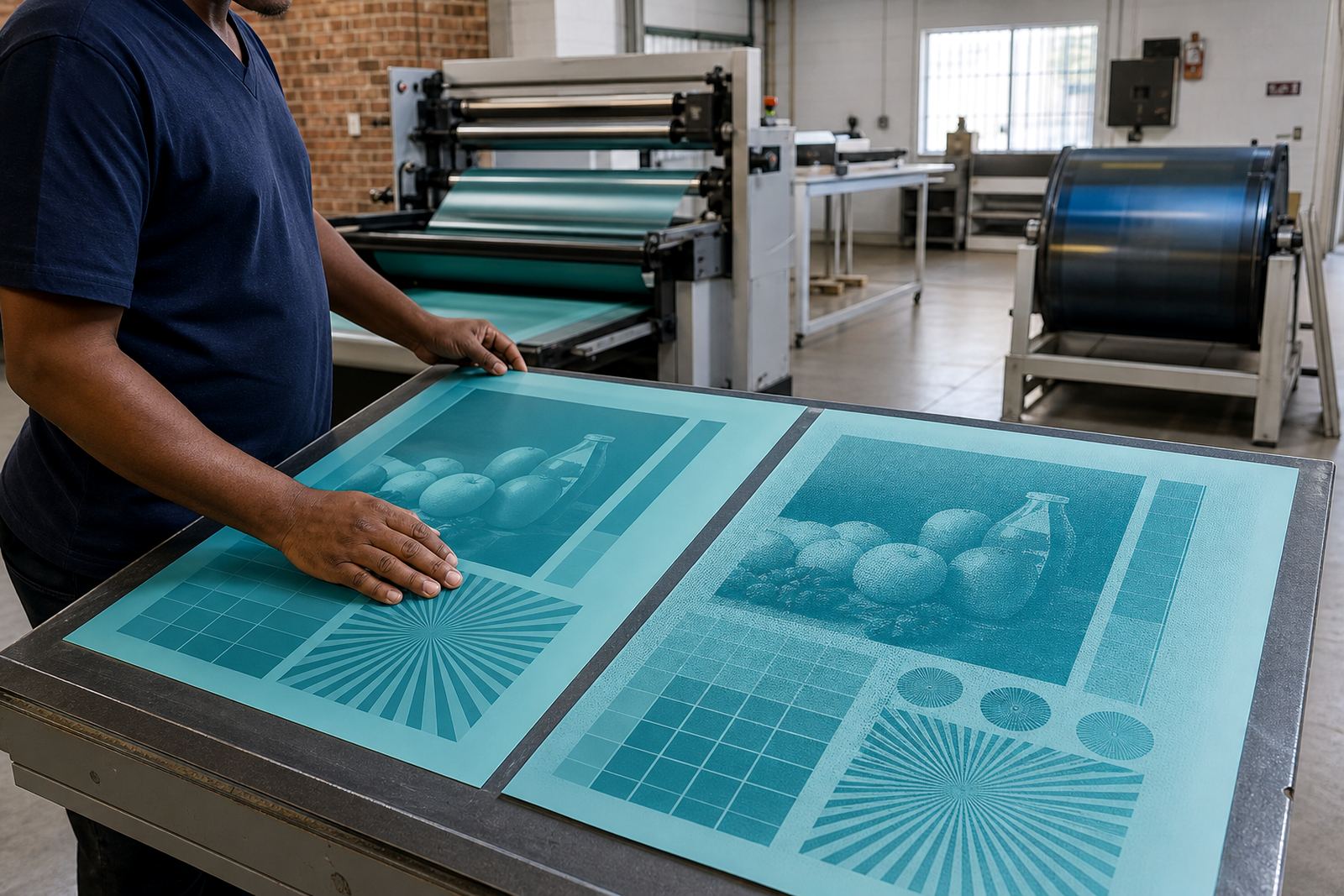
Why solids need a different plate approach
In flexo printing, a solid block of colour asks for even ink transfer across the whole area. A screened image, by contrast, depends on tiny dots holding shape, spacing and tone. If a plate is prepared the same way for both, one part of the job usually suffers. Solids can look patchy or starved, while screened work can fill in or lose detail.
That is why plate-making starts with the artwork, not just the cutter. During artwork preflight and file checking, we look at whether the job carries large solids, reverses, fine type, vignettes or tints. A carton panel with a deep blue block has very different demands from a label with a soft gradient and small barcode area. The plate needs enough support for the solid areas and enough control for the screens, sometimes on the same form.
For printers in Gauteng, especially where jobs move quickly between design changes and dispatch, this planning saves repeated rework. A plate that suits one part of the layout can cause trouble elsewhere if the solids and screens were not considered together from the start.
What happens to screened work on press
Screened images are sensitive because they rely on precise dot structure. Small dots can bridge, close up or weaken depending on impression, substrate and ink settings. On film labels, for example, a light 10% tint might print fine in one area and then show banding or fill-in after a tiny change in pressure. That is why screening support and proof comparison matter before plates leave the workshop.
Here are common issues that affect screened work:
- Dots filling in on softer materials or with too much impression
- Uneven tone when the anilox transfer is not matched to the screen range
- Break-up in very light tints if the dots are too small for the press setup
- Shadows or moiré when artwork, screen angle and line ruling are not planned together
For package and label printers, these details matter just as much as the final image. A clean screen can be the difference between a shelf-ready label and a job that needs sorting after the first run. You dont want to find that out on a full delivery pallet.
Where solids need pressure and where they need restraint
Large solids often need stronger plate support, but not more aggression. If a plate is trimmed badly or mounted unevenly, a solid area can show streaks, edge lift or pressure marks. In flexo, too much force does not improve a solid, it usually makes it worse. The aim is even contact, correct plate thickness and clean mounting so the image sits flat.
We also check whether the job needs special handling around the edges of solids. On packaging with heavy flood coats, a poor edge can show as a faint white line or a dark ridge. On labels, a solid black or dark green block can reveal small defects immediately under shop lighting. That is why plate trimming, plate labelling and mounting checks are part of the same workflow.
- Keep solid panels clean and evenly supported
- Check edges and corners for lifting before dispatch packing
- Match plate relief and backing to the press conditions
- Allow for substrate stretch on longer repeat lengths
Local production conditions change the result
Midrand sits between busy print routes in Johannesburg and Pretoria, and many jobs move quickly to Durban, Cape Town and Gqeberha by courier. That means a plate has to travel well too, not just print well. Heat in transport, dust in loading areas and coastal humidity in places like Durban and Gqeberha can affect how a job behaves once it reaches the pressroom. Packaging printers working with warehouse stock also need plates that arrive clearly labelled and protected.
Load-shedding adds another practical layer. When production stops and starts, files can be reopened, checked again and sent back into the queue. In that kind of schedule, plate-making has to stay organised. Clear file naming, accurate imposition planning and proper dispatch packing reduce the chance of a label plate being mistaken for a carton repeat or a remake being mixed with a fresh set.
We often see this with mixed jobs from East Rand and West Rand printers who run both short labels and larger packaging forms. The solids in one job may need a stronger impression strategy, while the screens in another need tighter dot control. Same pressroom, different demands.
How to brief a plate job with both solids and screens
If your artwork includes both heavy solids and screened images, the brief should tell us where each element sits and what the press is likely to do with it. The more detail the better. A simple note about the substrate, ink system and target finish can make a real difference when we are checking the file and planning the plate set.
Useful information to include with your enquiry:
- Artwork version and final size
- Whether the job is for labels, cartons or another pack format
- Substrate type, such as coated paper, film or board
- Any known trouble spots like light tints, reverses or small text
- Whether the job is a remake, revision or first run
Technical job advice is most useful when it starts early. If you ask after the press is already set up, the options can be narrower. A quick review before plate production gives time to adjust screening, check solids and avoid surprises on press.
A practical example from a Midrand label printer
Consider a Midrand label printer running a cosmetic label with a dark solid panel, a silver background area and a soft screened portrait. The solid panel needs even density so the product name stands out cleanly, while the portrait needs the dots to hold shape without filling in. At the same time, the silver area reflects light and can expose any plate fault immediately. One small fault, and the whole pack looks off.
In that kind of job, plate preparation cannot be treated as a single setting. The prepress team checks the artwork, compares proofs, plans the imposition and trims the plate so the image lands where it should. If the job is going to Durban for a client with coastal storage, we would also pay attention to labelling and packing so the plates stay identifiable and clean on arrival.
This is the everyday reality of solids and screening. They sit on the same sheet, but they do not ask for the same solution. Good plate-making respects that difference and gives the printer a better starting point.
What we handle before plates leave the workshop
At Flexo Printer Plates in Midrand, we work through the practical steps that help solids and screened images print as intended. That includes artwork preflight, file checking, imposition planning, screening support, proof comparison, plate making, plate trimming, plate labelling, remake support, dispatch packing and collection coordination. The point is not to add fuss. It is to make sure the plate suits the job before it reaches the pressroom.
Our team, led by Sibusiso Mthembu with support from Ayesha Naidoo, Pieter van Wyk, Lerato Molefe, Morne Jacobs and Zinhle Dlamini, handles work for label and packaging printers across Johannesburg, Pretoria, Durban, Cape Town and Gqeberha. If your next job mixes solids and screens, use the enquiry form on our contact page and send the artwork through for review.
That first check can save time, material and a fair bit of trouble later on.